Session 3: Measuring Abnormal Returns
Event Studies in Finance and Economics - Summer School
Learning Objectives
By the end of this session, you will be able to:
Calculate and interpret different measures of abnormal returns (AR, CAR, BHAR)
Understand the trade-offs between CAR and BHAR approaches
Compute standardized abnormal returns for improved inference
Translate abnormal returns into economic magnitudes (wealth effects)
Handle multiple events and aggregate abnormal returns across firms
1. Introduction: From Normal to Abnormal
In Sessions 1 and 2, we established how to estimate “normal” returns. Now we focus on measuring and interpreting the abnormal component — the return attributable to the event.
The Fundamental Equation
Where:
= Abnormal return for firm on day
= Actual (realized) return
= Expected (normal) return from our benchmark model
Why Measurement Matters
The choice of how we aggregate abnormal returns over time affects:
Statistical properties of our test statistics
Economic interpretation of the results
Comparability across studies
Bias in long-horizon studies
2. Setup and Data
Source
import numpy as np
import pandas as pd
import matplotlib.pyplot as plt
import seaborn as sns
from scipy import stats
import yfinance as yf
import statsmodels.api as sm
from datetime import datetime, timedelta
from typing import List, Dict, Tuple, Optional
import warnings
warnings.filterwarnings('ignore')

plt.style.use('seaborn-v0_8-whitegrid')
sns.set_palette("husl")

print("Libraries loaded successfully!")
Libraries loaded successfully!
Source
# We'll use multiple events to demonstrate aggregation
EVENTS = [
    {'ticker': 'AAPL', 'date': '2023-08-03', 'name': 'Apple Q3 Earnings'},
    {'ticker': 'MSFT', 'date': '2023-07-25', 'name': 'Microsoft Q4 Earnings'},
    {'ticker': 'GOOGL', 'date': '2023-07-25', 'name': 'Alphabet Q2 Earnings'},
    {'ticker': 'AMZN', 'date': '2023-08-03', 'name': 'Amazon Q2 Earnings'},
    {'ticker': 'META', 'date': '2023-07-26', 'name': 'Meta Q2 Earnings'},
]

ESTIMATION_WINDOW = 120
GAP = 10
EVENT_WINDOW_PRE = 10
EVENT_WINDOW_POST = 10

print(f"Analyzing {len(EVENTS)} earnings announcements")
for e in EVENTS:
    print(f"  {e['ticker']}: {e['name']} ({e['date']})")
Analyzing 5 earnings announcements
AAPL: Apple Q3 Earnings (2023-08-03)
MSFT: Microsoft Q4 Earnings (2023-07-25)
GOOGL: Alphabet Q2 Earnings (2023-07-25)
AMZN: Amazon Q2 Earnings (2023-08-03)
META: Meta Q2 Earnings (2023-07-26)
Source
def download_event_data(ticker: str, event_date: str, est_window: int,
                        gap: int, pre: int, post: int) -> Tuple[pd.DataFrame, pd.Timestamp]:
    """
    Download and prepare data for a single event.

    Returns:
    --------
    DataFrame with returns and event time, actual event date
    """
    event_dt = pd.to_datetime(event_date)
    start_date = event_dt - timedelta(days=int((est_window + gap + pre) * 1.5))
    end_date = event_dt + timedelta(days=int(post * 2.5))

    stock = yf.download(ticker, start=start_date, end=end_date, progress=False)['Close']
    market = yf.download('^GSPC', start=start_date, end=end_date, progress=False)['Close']

    df = pd.DataFrame({
        'stock_price': stock.squeeze(),
        'market_price': market.squeeze()
    })

    df['stock_ret'] = df['stock_price'].pct_change()
    df['market_ret'] = df['market_price'].pct_change()
    df = df.dropna()

    # Adjust event date if not a trading day
    if event_dt not in df.index:
        idx = df.index.get_indexer([event_dt], method='nearest')[0]
        event_dt = df.index[idx]

    event_idx = df.index.get_loc(event_dt)
    df['event_time'] = range(-event_idx, len(df) - event_idx)

    return df, event_dt


def estimate_market_model(est_data: pd.DataFrame) -> Dict:
    """
    Estimate market model parameters.
    """
    y = est_data['stock_ret'].values
    x = est_data['market_ret'].values
    X = sm.add_constant(x)
    results = sm.OLS(y, X).fit()

    return {
        'alpha': results.params[0],
        'beta': results.params[1],
        'sigma': np.std(results.resid, ddof=2),
        'r_squared': results.rsquared,
        'n_obs': len(y),
        'market_mean': np.mean(x),
        'market_var': np.sum((x - np.mean(x))**2)
    }


def process_single_event(event: Dict, est_window: int, gap: int,
                         pre: int, post: int) -> Dict:
    """
    Process a single event: download data, estimate model, calculate ARs.
    """
    data, actual_date = download_event_data(
        event['ticker'], event['date'], est_window, gap, pre, post
    )

    # Split windows
    est_end = -(gap + pre)
    est_start = est_end - est_window

    est_data = data[(data['event_time'] >= est_start) & (data['event_time'] < est_end)]
    evt_data = data[(data['event_time'] >= -pre) & (data['event_time'] <= post)].copy()

    # Estimate model
    model = estimate_market_model(est_data)

    # Calculate expected and abnormal returns
    evt_data['expected_ret'] = model['alpha'] + model['beta'] * evt_data['market_ret']
    evt_data['AR'] = evt_data['stock_ret'] - evt_data['expected_ret']

    return {
        'ticker': event['ticker'],
        'name': event['name'],
        'event_date': actual_date,
        'model': model,
        'event_data': evt_data,
        'estimation_data': est_data
    }


# Process all events
print("Processing events...")
event_results = []
for event in EVENTS:
    try:
        result = process_single_event(event, ESTIMATION_WINDOW, GAP,
                                       EVENT_WINDOW_PRE, EVENT_WINDOW_POST)
        event_results.append(result)
        print(f"  {event['ticker']}: OK (beta={result['model']['beta']:.3f})")
    except Exception as e:
        print(f"  {event['ticker']}: FAILED - {e}")

print(f"\nSuccessfully processed {len(event_results)} events")
Processing events...
YF.download() has changed argument auto_adjust default to True
AAPL: OK (beta=1.127)
MSFT: OK (beta=1.249)
GOOGL: OK (beta=1.404)
AMZN: OK (beta=1.521)
META: OK (beta=1.891)
Successfully processed 5 events
3. Daily Abnormal Returns (AR)
Definition
The daily abnormal return is simply the difference between actual and expected return:
Properties
Under the null hypothesis of no event effect:
The variance includes:
Residual variance from the market model
Estimation error in alpha
Estimation error in beta (larger when market return is extreme)
Source
def calculate_ar_variance(model: Dict, market_returns: np.ndarray) -> np.ndarray:
    """
    Calculate the variance of abnormal returns accounting for estimation error.

    Var(AR) = sigma^2 * [1 + 1/T + (Rm - Rm_bar)^2 / sum((Rm - Rm_bar)^2)]
    """
    sigma_sq = model['sigma'] ** 2
    T = model['n_obs']
    Rm_bar = model['market_mean']
    sum_sq = model['market_var']

    variance = sigma_sq * (
        1 +
        1/T +
        (market_returns - Rm_bar)**2 / sum_sq
    )

    return variance


# Display AR for first event
example = event_results[0]
evt_data = example['event_data'].copy()

# Add variance and standard error
evt_data['AR_var'] = calculate_ar_variance(example['model'], evt_data['market_ret'].values)
evt_data['AR_se'] = np.sqrt(evt_data['AR_var'])

print(f"Daily Abnormal Returns: {example['ticker']} ({example['name']})")
print("="*80)

display_df = evt_data[['event_time', 'stock_ret', 'market_ret', 'expected_ret', 'AR', 'AR_se']].copy()
display_df.index = evt_data.index.strftime('%Y-%m-%d')
for col in ['stock_ret', 'market_ret', 'expected_ret', 'AR', 'AR_se']:
    display_df[col] = display_df[col].apply(lambda x: f"{x*100:.2f}%")

print(display_df.to_string())
Daily Abnormal Returns: AAPL (Apple Q3 Earnings)
================================================================================
event_time stock_ret market_ret expected_ret AR AR_se
Date
2023-07-20 -10 -1.01% -0.68% -0.56% -0.45% 0.81%
2023-07-21 -9 -0.62% 0.03% 0.24% -0.86% 0.81%
2023-07-24 -8 0.42% 0.40% 0.66% -0.24% 0.81%
2023-07-25 -7 0.45% 0.28% 0.52% -0.07% 0.81%
2023-07-26 -6 0.45% -0.02% 0.19% 0.27% 0.81%
2023-07-27 -5 -0.66% -0.64% -0.52% -0.14% 0.81%
2023-07-28 -4 1.35% 0.99% 1.32% 0.03% 0.81%
2023-07-31 -3 0.32% 0.15% 0.37% -0.05% 0.81%
2023-08-01 -2 -0.43% -0.27% -0.09% -0.33% 0.81%
2023-08-02 -1 -1.55% -1.38% -1.35% -0.20% 0.82%
2023-08-03 0 -0.73% -0.25% -0.08% -0.65% 0.81%
2023-08-04 1 -4.80% -0.53% -0.39% -4.41% 0.81%
2023-08-07 2 -1.73% 0.90% 1.22% -2.95% 0.81%
2023-08-08 3 0.53% -0.42% -0.27% 0.80% 0.81%
2023-08-09 4 -0.90% -0.70% -0.59% -0.31% 0.81%
2023-08-10 5 -0.12% 0.03% 0.23% -0.36% 0.81%
2023-08-11 6 0.03% -0.11% 0.08% -0.05% 0.81%
2023-08-14 7 0.94% 0.58% 0.85% 0.09% 0.81%
2023-08-15 8 -1.12% -1.16% -1.10% -0.02% 0.81%
2023-08-16 9 -0.50% -0.76% -0.65% 0.15% 0.81%
2023-08-17 10 -1.46% -0.77% -0.66% -0.79% 0.81%
Source
# Visualize daily ARs for all events
fig, axes = plt.subplots(2, 3, figsize=(15, 8))
axes = axes.flatten()

for i, result in enumerate(event_results):
    if i >= 5:
        break
    ax = axes[i]
    evt = result['event_data']

    colors = ['green' if ar >= 0 else 'red' for ar in evt['AR']]
    ax.bar(evt['event_time'], evt['AR']*100, color=colors, alpha=0.7, edgecolor='black')
    ax.axhline(0, color='black', linewidth=0.5)
    ax.axvline(0, color='blue', linestyle='--', alpha=0.7, label='Event Day')

    ax.set_xlabel('Event Time')
    ax.set_ylabel('AR (%)')
    ax.set_title(f"{result['ticker']}: {result['name']}")
    ax.set_xticks(range(-EVENT_WINDOW_PRE, EVENT_WINDOW_POST+1, 5))

# Hide empty subplot
axes[5].axis('off')

plt.tight_layout()
plt.show()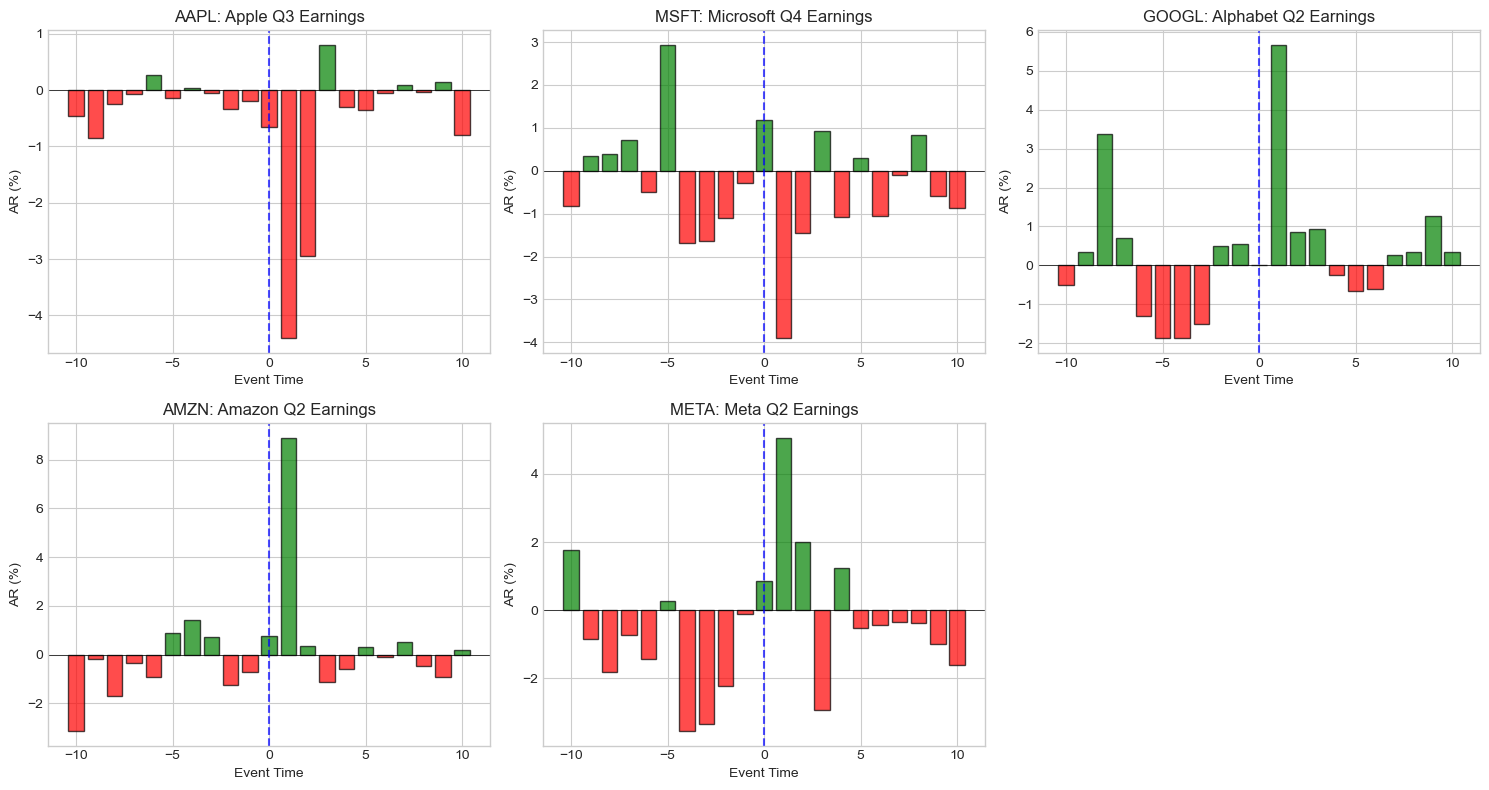
4. Cumulative Abnormal Returns (CAR)
Definition
The CAR sums daily abnormal returns over an event window:
Common Windows
| Window | Interpretation |
|---|---|
| CAR(0, 0) | Event day only |
| CAR(-1, +1) | Three-day window (captures leakage and delayed reaction) |
| CAR(-5, +5) | Eleven-day window |
| CAR(0, +T) | Post-event drift |
| CAR(-T, -1) | Pre-event anticipation |
Variance of CAR
Assuming independence across days:
For the simplified case (ignoring estimation error):
Source
def calculate_car(event_data: pd.DataFrame, tau1: int, tau2: int) -> float:
    """
    Calculate Cumulative Abnormal Return for a window.

    Parameters:
    -----------
    event_data : DataFrame with 'event_time' and 'AR' columns
    tau1, tau2 : Start and end of window (inclusive)

    Returns:
    --------
    CAR value
    """
    mask = (event_data['event_time'] >= tau1) & (event_data['event_time'] <= tau2)
    return event_data.loc[mask, 'AR'].sum()


def calculate_car_variance(model: Dict, event_data: pd.DataFrame,
                           tau1: int, tau2: int) -> float:
    """
    Calculate variance of CAR accounting for estimation error.
    """
    mask = (event_data['event_time'] >= tau1) & (event_data['event_time'] <= tau2)
    window_data = event_data[mask]

    ar_variances = calculate_ar_variance(model, window_data['market_ret'].values)
    return np.sum(ar_variances)


def calculate_all_cars(result: Dict, windows: List[Tuple[int, int]]) -> pd.DataFrame:
    """
    Calculate CARs for multiple windows.
    """
    cars = []
    for tau1, tau2 in windows:
        car = calculate_car(result['event_data'], tau1, tau2)
        car_var = calculate_car_variance(result['model'], result['event_data'], tau1, tau2)
        car_se = np.sqrt(car_var)
        t_stat = car / car_se if car_se > 0 else 0

        cars.append({
            'Window': f'[{tau1:+d}, {tau2:+d}]',
            'CAR': car,
            'SE': car_se,
            't-stat': t_stat,
            'p-value': 2 * (1 - stats.t.cdf(abs(t_stat), df=result['model']['n_obs']-2))
        })

    return pd.DataFrame(cars)


# Calculate CARs for standard windows
standard_windows = [
    (-10, -2),   # Pre-event
    (-1, +1),    # Standard 3-day
    (0, 0),      # Event day
    (-5, +5),    # 11-day window
    (+2, +10),   # Post-event drift
    (-10, +10),  # Full window
]

print("CARs by Event and Window:")
print("="*90)

for result in event_results:
    print(f"\n{result['ticker']}: {result['name']}")
    cars_df = calculate_all_cars(result, standard_windows)

    # Format for display
    display_df = cars_df.copy()
    display_df['CAR'] = display_df['CAR'].apply(lambda x: f"{x*100:+.2f}%")
    display_df['SE'] = display_df['SE'].apply(lambda x: f"{x*100:.2f}%")
    display_df['t-stat'] = display_df['t-stat'].apply(lambda x: f"{x:.3f}")
    display_df['p-value'] = display_df['p-value'].apply(lambda x: f"{x:.4f}")

    print(display_df.to_string(index=False))
CARs by Event and Window:
==========================================================================================
AAPL: Apple Q3 Earnings
Window CAR SE t-stat p-value
[-10, -2] -1.85% 2.42% -0.763 0.4470
[-1, +1] -5.26% 1.40% -3.744 0.0003
[+0, +0] -0.65% 0.81% -0.806 0.4219
[-5, +5] -8.56% 2.68% -3.192 0.0018
[+2, +10] -3.44% 2.43% -1.419 0.1586
[-10, +10] -10.55% 3.71% -2.847 0.0052
MSFT: Microsoft Q4 Earnings
Window CAR SE t-stat p-value
[-10, -2] -1.35% 4.22% -0.319 0.7503
[-1, +1] -3.00% 2.43% -1.232 0.2205
[+0, +0] +1.19% 1.40% 0.845 0.3999
[-5, +5] -5.78% 4.66% -1.241 0.2172
[+2, +10] -3.07% 4.23% -0.727 0.4688
[-10, +10] -7.41% 6.45% -1.150 0.2526
GOOGL: Alphabet Q2 Earnings
Window CAR SE t-stat p-value
[-10, -2] -2.11% 5.01% -0.421 0.6743
[-1, +1] +6.22% 2.89% 2.155 0.0332
[+0, +0] +0.02% 1.67% 0.012 0.9902
[-5, +5] +2.37% 5.53% 0.428 0.6696
[+2, +10] +2.49% 5.01% 0.497 0.6200
[-10, +10] +6.61% 7.65% 0.863 0.3896
AMZN: Amazon Q2 Earnings
Window CAR SE t-stat p-value
[-10, -2] -4.50% 5.29% -0.850 0.3972
[-1, +1] +8.96% 3.07% 2.924 0.0041
[+0, +0] +0.76% 1.76% 0.434 0.6652
[-5, +5] +9.68% 5.86% 1.652 0.1012
[+2, +10] -1.84% 5.30% -0.347 0.7292
[-10, +10] +2.63% 8.09% 0.325 0.7458
META: Meta Q2 Earnings
Window CAR SE t-stat p-value
[-10, -2] -11.84% 7.72% -1.533 0.1278
[-1, +1] +5.84% 4.46% 1.310 0.1926
[+0, +0] +0.87% 2.57% 0.340 0.7347
[-5, +5] -3.20% 8.55% -0.375 0.7087
[+2, +10] -3.94% 7.74% -0.509 0.6114
[-10, +10] -9.94% 11.81% -0.842 0.4014
Source
# Plot cumulative ARs over the event window
fig, ax = plt.subplots(figsize=(12, 6))

for result in event_results:
    evt = result['event_data'].sort_values('event_time')
    car = evt['AR'].cumsum()
    ax.plot(evt['event_time'], car * 100, 'o-', label=result['ticker'],
            markersize=4, linewidth=1.5)

ax.axhline(0, color='black', linewidth=0.5)
ax.axvline(0, color='red', linestyle='--', alpha=0.7, label='Event Day')

ax.set_xlabel('Event Time (Trading Days)', fontsize=12)
ax.set_ylabel('Cumulative Abnormal Return (%)', fontsize=12)
ax.set_title('Cumulative Abnormal Returns Around Earnings Announcements', fontsize=14)
ax.legend(loc='best')
ax.grid(True, alpha=0.3)
ax.set_xticks(range(-EVENT_WINDOW_PRE, EVENT_WINDOW_POST+1, 2))

plt.tight_layout()
plt.show()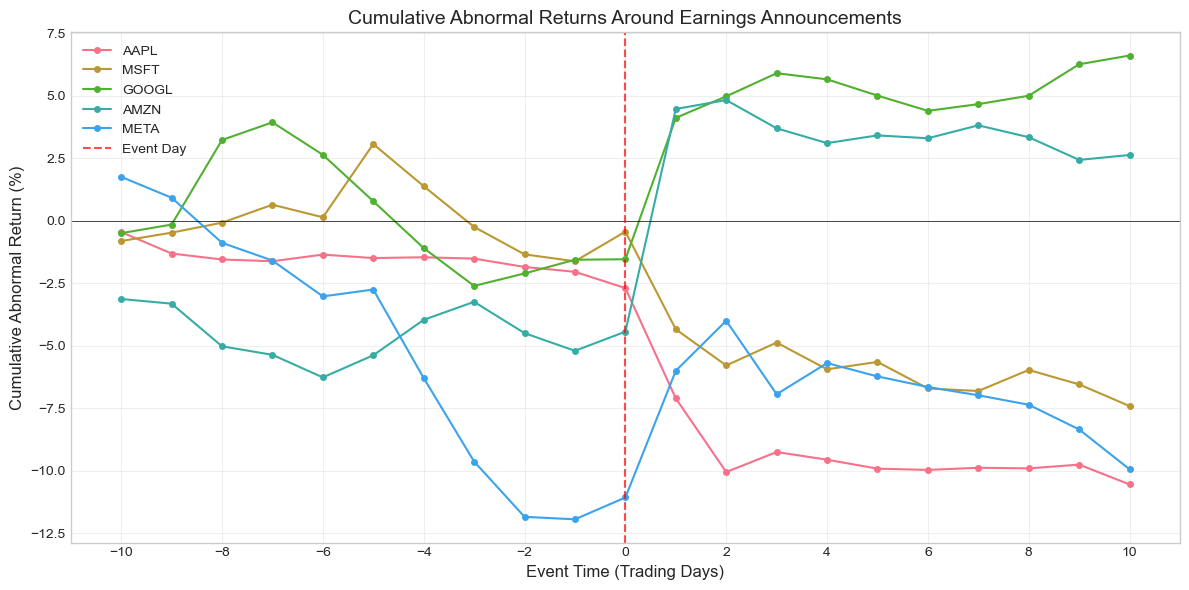
5. Buy-and-Hold Abnormal Returns (BHAR)
Definition
BHAR compounds returns rather than summing them:
Or equivalently:
CAR vs. BHAR
| Aspect | CAR | BHAR |
|---|---|---|
| Calculation | Sum of ARs | Compound returns |
| Interpretation | Average daily abnormal return × days | Actual wealth change |
| Statistical properties | Better understood | Right-skewed distribution |
| Short horizons | Very similar | Very similar |
| Long horizons | May understate compounding | Captures true investor experience |
| Bias | Less sensitive to outliers | Sensitive to extreme returns |
Source
def calculate_bhar(event_data: pd.DataFrame, tau1: int, tau2: int) -> float:
    """
    Calculate Buy-and-Hold Abnormal Return.

    BHAR = Product(1 + R_actual) - Product(1 + R_expected)
    """
    mask = (event_data['event_time'] >= tau1) & (event_data['event_time'] <= tau2)
    window_data = event_data[mask]

    # Compound actual returns
    actual_wealth = np.prod(1 + window_data['stock_ret'].values)

    # Compound expected returns
    expected_wealth = np.prod(1 + window_data['expected_ret'].values)

    return actual_wealth - expected_wealth


def calculate_bhar_market_adjusted(event_data: pd.DataFrame, tau1: int, tau2: int) -> float:
    """
    Calculate market-adjusted BHAR (simple benchmark).

    BHAR = Product(1 + R_stock) - Product(1 + R_market)
    """
    mask = (event_data['event_time'] >= tau1) & (event_data['event_time'] <= tau2)
    window_data = event_data[mask]

    stock_wealth = np.prod(1 + window_data['stock_ret'].values)
    market_wealth = np.prod(1 + window_data['market_ret'].values)

    return stock_wealth - market_wealth


# Compare CAR and BHAR
print("CAR vs BHAR Comparison:")
print("="*90)

comparison_windows = [(-1, +1), (-5, +5), (-10, +10)]

comparison_data = []
for result in event_results:
    for tau1, tau2 in comparison_windows:
        car = calculate_car(result['event_data'], tau1, tau2)
        bhar = calculate_bhar(result['event_data'], tau1, tau2)
        bhar_ma = calculate_bhar_market_adjusted(result['event_data'], tau1, tau2)

        comparison_data.append({
            'Ticker': result['ticker'],
            'Window': f'[{tau1:+d},{tau2:+d}]',
            'CAR': car,
            'BHAR': bhar,
            'BHAR_MA': bhar_ma,
            'Diff (BHAR-CAR)': bhar - car
        })

comp_df = pd.DataFrame(comparison_data)

# Format for display
display_comp = comp_df.copy()
for col in ['CAR', 'BHAR', 'BHAR_MA', 'Diff (BHAR-CAR)']:
    display_comp[col] = display_comp[col].apply(lambda x: f"{x*100:+.3f}%")

print(display_comp.to_string(index=False))
CAR vs BHAR Comparison:
==========================================================================================
Ticker Window CAR BHAR BHAR_MA Diff (BHAR-CAR)
AAPL [-1,+1] -5.256% -5.143% -4.806% +0.114%
AAPL [-5,+5] -8.562% -8.315% -6.355% +0.246%
AAPL [-10,+10] -10.547% -10.083% -6.416% +0.465%
MSFT [-1,+1] -2.997% -3.074% -2.416% -0.077%
MSFT [-5,+5] -5.785% -6.031% -3.909% -0.246%
MSFT [-10,+10] -7.413% -7.835% -3.779% -0.422%
GOOGL [-1,+1] +6.223% +6.330% +7.037% +0.107%
GOOGL [-5,+5] +2.368% +2.247% +4.343% -0.121%
GOOGL [-10,+10] +6.607% +6.841% +10.801% +0.234%
AMZN [-1,+1] +8.965% +8.758% +8.140% -0.207%
AMZN [-5,+5] +9.680% +9.570% +10.267% -0.110%
AMZN [-10,+10] +2.629% +2.067% +3.259% -0.563%
META [-1,+1] +5.842% +5.965% +7.271% +0.124%
META [-5,+5] -3.200% -3.621% +1.637% -0.420%
META [-10,+10] -9.942% -11.126% +1.679% -1.184%
Source
# Visualize CAR vs BHAR over time for one event
example = event_results[0]
evt = example['event_data'].sort_values('event_time')

# Calculate running CAR and BHAR
car_series = evt['AR'].cumsum()

bhar_series = []
start_time = evt['event_time'].min()
for t in evt['event_time']:
    bhar = calculate_bhar(evt, start_time, t)
    bhar_series.append(bhar)

fig, ax = plt.subplots(figsize=(12, 5))

ax.plot(evt['event_time'], car_series * 100, 'b-o', label='CAR', markersize=5)
ax.plot(evt['event_time'], np.array(bhar_series) * 100, 'r-s', label='BHAR', markersize=5)

ax.axhline(0, color='black', linewidth=0.5)
ax.axvline(0, color='green', linestyle='--', alpha=0.7)

ax.set_xlabel('Event Time', fontsize=12)
ax.set_ylabel('Abnormal Return (%)', fontsize=12)
ax.set_title(f'{example["ticker"]}: CAR vs BHAR Comparison', fontsize=14)
ax.legend()
ax.grid(True, alpha=0.3)

plt.tight_layout()
plt.show()

print(f"\nFor short windows, CAR and BHAR are nearly identical.")
print(f"Difference at day +{EVENT_WINDOW_POST}: {(bhar_series[-1] - car_series.iloc[-1])*100:.4f}%")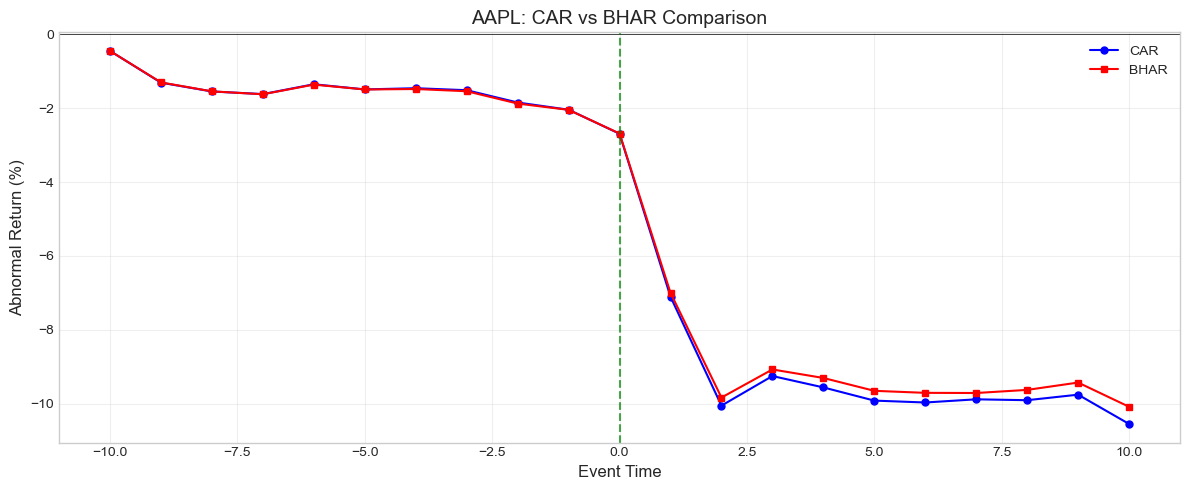
For short windows, CAR and BHAR are nearly identical.
Difference at day +10: 0.4646%
6. Standardized Abnormal Returns (SAR)
Motivation
Raw abnormal returns have different variances across firms. Standardization improves cross-sectional comparability and statistical power.
Definition
Where:
Standardized CAR (SCAR)
Where:
Under the null: approximately for large T.
Source
def calculate_standardized_ar(event_data: pd.DataFrame, model: Dict) -> pd.Series:
    """
    Calculate Standardized Abnormal Returns (SAR).

    SAR = AR / sigma_AR
    """
    ar_var = calculate_ar_variance(model, event_data['market_ret'].values)
    ar_se = np.sqrt(ar_var)

    sar = event_data['AR'].values / ar_se
    return pd.Series(sar, index=event_data.index)


def calculate_standardized_car(event_data: pd.DataFrame, model: Dict,
                                tau1: int, tau2: int) -> Tuple[float, float]:
    """
    Calculate Standardized CAR (SCAR).

    Returns: (SCAR, CAR)
    """
    car = calculate_car(event_data, tau1, tau2)
    car_var = calculate_car_variance(model, event_data, tau1, tau2)
    car_se = np.sqrt(car_var)

    scar = car / car_se if car_se > 0 else 0
    return scar, car


# Calculate SARs for all events
print("Standardized Abnormal Returns (SAR):")
print("="*90)

for result in event_results:
    evt = result['event_data'].copy()
    evt['SAR'] = calculate_standardized_ar(evt, result['model'])

    # Display around event day
    display_data = evt[(evt['event_time'] >= -3) & (evt['event_time'] <= 3)]

    print(f"\n{result['ticker']}:")
    disp = display_data[['event_time', 'AR', 'SAR']].copy()
    disp['AR'] = disp['AR'].apply(lambda x: f"{x*100:+.2f}%")
    disp['SAR'] = disp['SAR'].apply(lambda x: f"{x:+.3f}")
    print(disp.to_string(index=False))
Standardized Abnormal Returns (SAR):
==========================================================================================
AAPL:
event_time AR SAR
-3 -0.05% -0.067
-2 -0.33% -0.412
-1 -0.20% -0.239
0 -0.65% -0.806
1 -4.41% -5.456
2 -2.95% -3.642
3 +0.80% +0.992
MSFT:
event_time AR SAR
-3 -1.63% -1.158
-2 -1.10% -0.781
-1 -0.28% -0.197
0 +1.19% +0.845
1 -3.91% -2.782
2 -1.45% -1.028
3 +0.92% +0.650
GOOGL:
event_time AR SAR
-3 -1.51% -0.906
-2 +0.50% +0.299
-1 +0.55% +0.328
0 +0.02% +0.012
1 +5.65% +3.393
2 +0.86% +0.514
3 +0.93% +0.554
AMZN:
event_time AR SAR
-3 +0.72% +0.409
-2 -1.25% -0.710
-1 -0.71% -0.397
0 +0.76% +0.434
1 +8.91% +5.045
2 +0.36% +0.202
3 -1.13% -0.641
META:
event_time AR SAR
-3 -3.34% -1.299
-2 -2.21% -0.860
-1 -0.10% -0.039
0 +0.87% +0.340
1 +5.07% +1.966
2 +2.00% +0.775
3 -2.94% -1.143
Source
# Compare SCARs across events
print("\nStandardized CAR (SCAR) Comparison:")
print("="*80)

scar_data = []
for result in event_results:
    for tau1, tau2 in [(-1, +1), (0, 0), (-5, +5)]:
        scar, car = calculate_standardized_car(result['event_data'], result['model'], tau1, tau2)

        scar_data.append({
            'Ticker': result['ticker'],
            'Window': f'[{tau1:+d},{tau2:+d}]',
            'CAR': car,
            'SCAR': scar,
            'Significant': '***' if abs(scar) > 2.576 else '**' if abs(scar) > 1.96 else '*' if abs(scar) > 1.645 else ''
        })

scar_df = pd.DataFrame(scar_data)
display_scar = scar_df.copy()
display_scar['CAR'] = display_scar['CAR'].apply(lambda x: f"{x*100:+.2f}%")
display_scar['SCAR'] = display_scar['SCAR'].apply(lambda x: f"{x:+.3f}")

print(display_scar.to_string(index=False))
print("\nSignificance: * p<0.10, ** p<0.05, *** p<0.01")
Standardized CAR (SCAR) Comparison:
================================================================================
Ticker  Window    CAR   SCAR Significant
  AAPL [-1,+1] -5.26% -3.744         ***
  AAPL [+0,+0] -0.65% -0.806
  AAPL [-5,+5] -8.56% -3.192         ***
  MSFT [-1,+1] -3.00% -1.232
  MSFT [+0,+0] +1.19% +0.845
  MSFT [-5,+5] -5.78% -1.241
 GOOGL [-1,+1] +6.22% +2.155          **
 GOOGL [+0,+0] +0.02% +0.012
 GOOGL [-5,+5] +2.37% +0.428
  AMZN [-1,+1] +8.96% +2.924         ***
  AMZN [+0,+0] +0.76% +0.434
  AMZN [-5,+5] +9.68% +1.652           *
  META [-1,+1] +5.84% +1.310
  META [+0,+0] +0.87% +0.340
  META [-5,+5] -3.20% -0.375

Significance: * p<0.10, ** p<0.05, *** p<0.01
7. Aggregating Across Events
Average Abnormal Return (AAR)
For a sample of events:
Cumulative Average Abnormal Return (CAAR)
Variance of CAAR
Assuming independence across firms (no event clustering):
Source
def calculate_aar_series(event_results: List[Dict]) -> pd.DataFrame:
    """
    Calculate Average Abnormal Return for each event time.
    """
    # Collect all ARs by event time
    ar_by_time = {}

    for result in event_results:
        evt = result['event_data']
        for _, row in evt.iterrows():
            t = int(row['event_time'])
            if t not in ar_by_time:
                ar_by_time[t] = []
            ar_by_time[t].append(row['AR'])

    # Calculate statistics
    aar_data = []
    for t in sorted(ar_by_time.keys()):
        ars = np.array(ar_by_time[t])
        n = len(ars)
        aar = np.mean(ars)
        std = np.std(ars, ddof=1) if n > 1 else 0
        se = std / np.sqrt(n) if n > 0 else 0
        t_stat = aar / se if se > 0 else 0

        aar_data.append({
            'event_time': t,
            'N': n,
            'AAR': aar,
            'Std': std,
            'SE': se,
            't-stat': t_stat
        })

    return pd.DataFrame(aar_data)


def calculate_caar(event_results: List[Dict], tau1: int, tau2: int) -> Dict:
    """
    Calculate Cumulative Average Abnormal Return and test statistics.
    """
    cars = []
    car_vars = []

    for result in event_results:
        car = calculate_car(result['event_data'], tau1, tau2)
        car_var = calculate_car_variance(result['model'], result['event_data'], tau1, tau2)
        cars.append(car)
        car_vars.append(car_var)

    cars = np.array(cars)
    car_vars = np.array(car_vars)
    N = len(cars)

    caar = np.mean(cars)

    # Cross-sectional standard error
    cs_se = np.std(cars, ddof=1) / np.sqrt(N)

    # Time-series standard error (assuming independence)
    ts_var = np.sum(car_vars) / (N**2)
    ts_se = np.sqrt(ts_var)

    return {
        'CAAR': caar,
        'N': N,
        'CS_SE': cs_se,
        'TS_SE': ts_se,
        't_stat_CS': caar / cs_se if cs_se > 0 else 0,
        't_stat_TS': caar / ts_se if ts_se > 0 else 0,
        'individual_CARs': cars
    }


# Calculate AAR series
aar_df = calculate_aar_series(event_results)

print("Average Abnormal Returns (AAR) by Event Time:")
print("="*70)

display_aar = aar_df.copy()
display_aar['AAR'] = display_aar['AAR'].apply(lambda x: f"{x*100:+.3f}%")
display_aar['SE'] = display_aar['SE'].apply(lambda x: f"{x*100:.3f}%")
display_aar['t-stat'] = display_aar['t-stat'].apply(lambda x: f"{x:+.3f}")

print(display_aar.to_string(index=False))
Average Abnormal Returns (AAR) by Event Time:
======================================================================
event_time N AAR Std SE t-stat
-10 5 -0.628% 0.017335 0.775% -0.810
-9 5 -0.240% 0.005934 0.265% -0.906
-8 5 +0.007% 0.021109 0.944% +0.008
-7 5 +0.061% 0.006370 0.285% +0.213
-6 5 -0.774% 0.006864 0.307% -2.523
-5 5 +0.419% 0.017342 0.776% +0.540
-4 5 -1.129% 0.019040 0.852% -1.326
-3 5 -1.164% 0.015696 0.702% -1.658
-2 5 -0.879% 0.010196 0.456% -1.927
-1 5 -0.146% 0.004520 0.202% -0.723
0 5 +0.439% 0.007444 0.333% +1.319
1 5 +2.262% 0.060438 2.703% +0.837
2 5 -0.235% 0.019606 0.877% -0.268
3 5 -0.285% 0.017214 0.770% -0.370
4 5 -0.194% 0.008681 0.388% -0.499
5 5 -0.188% 0.004589 0.205% -0.914
6 5 -0.452% 0.004102 0.183% -2.464
7 5 +0.088% 0.003273 0.146% +0.601
8 5 +0.060% 0.005417 0.242% +0.248
9 5 -0.214% 0.009375 0.419% -0.509
10 5 -0.541% 0.008085 0.362% -1.496
Source
# Calculate CAAR for standard windows
print("\nCumulative Average Abnormal Returns (CAAR):")
print("="*80)

caar_results = []
for tau1, tau2 in standard_windows:
    result = calculate_caar(event_results, tau1, tau2)
    caar_results.append({
        'Window': f'[{tau1:+d}, {tau2:+d}]',
        'N': result['N'],
        'CAAR': result['CAAR'],
        'CS_SE': result['CS_SE'],
        't-stat (CS)': result['t_stat_CS'],
        't-stat (TS)': result['t_stat_TS']
    })

caar_df = pd.DataFrame(caar_results)

display_caar = caar_df.copy()
display_caar['CAAR'] = display_caar['CAAR'].apply(lambda x: f"{x*100:+.3f}%")
display_caar['CS_SE'] = display_caar['CS_SE'].apply(lambda x: f"{x*100:.3f}%")
display_caar['t-stat (CS)'] = display_caar['t-stat (CS)'].apply(lambda x: f"{x:+.3f}")
display_caar['t-stat (TS)'] = display_caar['t-stat (TS)'].apply(lambda x: f"{x:+.3f}")

print(display_caar.to_string(index=False))
print("\nCS = Cross-sectional, TS = Time-series standard errors")
Cumulative Average Abnormal Returns (CAAR):
================================================================================
    Window  N    CAAR  CS_SE t-stat (CS) t-stat (TS)
 [-10, -2]  5 -4.328% 1.955%      -2.214      -1.853
  [-1, +1]  5 +2.555% 2.803%      +0.912      +1.894
  [+0, +0]  5 +0.439% 0.333%      +1.319      +0.564
  [-5, +5]  5 -1.100% 3.242%      -0.339      -0.426
 [+2, +10]  5 -1.960% 1.166%      -1.681      -0.838
[-10, +10]  5 -3.733% 3.507%      -1.065      -1.046

CS = Cross-sectional, TS = Time-series standard errors
Source
# Plot CAAR with confidence bands
aar_df['CAAR'] = aar_df['AAR'].cumsum()

# Calculate running standard error for CAAR
# Simplified: assume constant variance
aar_df['CAAR_SE'] = aar_df['SE'] * np.sqrt(np.arange(1, len(aar_df) + 1))

fig, axes = plt.subplots(1, 2, figsize=(14, 5))

# AAR plot
ax1 = axes[0]
colors = ['green' if aar >= 0 else 'red' for aar in aar_df['AAR']]
ax1.bar(aar_df['event_time'], aar_df['AAR']*100, color=colors, alpha=0.7, edgecolor='black')
ax1.axhline(0, color='black', linewidth=0.5)
ax1.axvline(0, color='blue', linestyle='--', alpha=0.7)
ax1.set_xlabel('Event Time', fontsize=12)
ax1.set_ylabel('AAR (%)', fontsize=12)
ax1.set_title('Average Abnormal Returns', fontsize=14)

# CAAR plot with confidence bands
ax2 = axes[1]
ax2.plot(aar_df['event_time'], aar_df['CAAR']*100, 'b-o', markersize=5, label='CAAR')
ax2.fill_between(aar_df['event_time'],
                  (aar_df['CAAR'] - 1.96*aar_df['CAAR_SE'])*100,
                  (aar_df['CAAR'] + 1.96*aar_df['CAAR_SE'])*100,
                  alpha=0.3, label='95% CI')
ax2.axhline(0, color='black', linewidth=0.5)
ax2.axvline(0, color='red', linestyle='--', alpha=0.7)
ax2.set_xlabel('Event Time', fontsize=12)
ax2.set_ylabel('CAAR (%)', fontsize=12)
ax2.set_title('Cumulative Average Abnormal Returns', fontsize=14)
ax2.legend()

plt.tight_layout()
plt.show()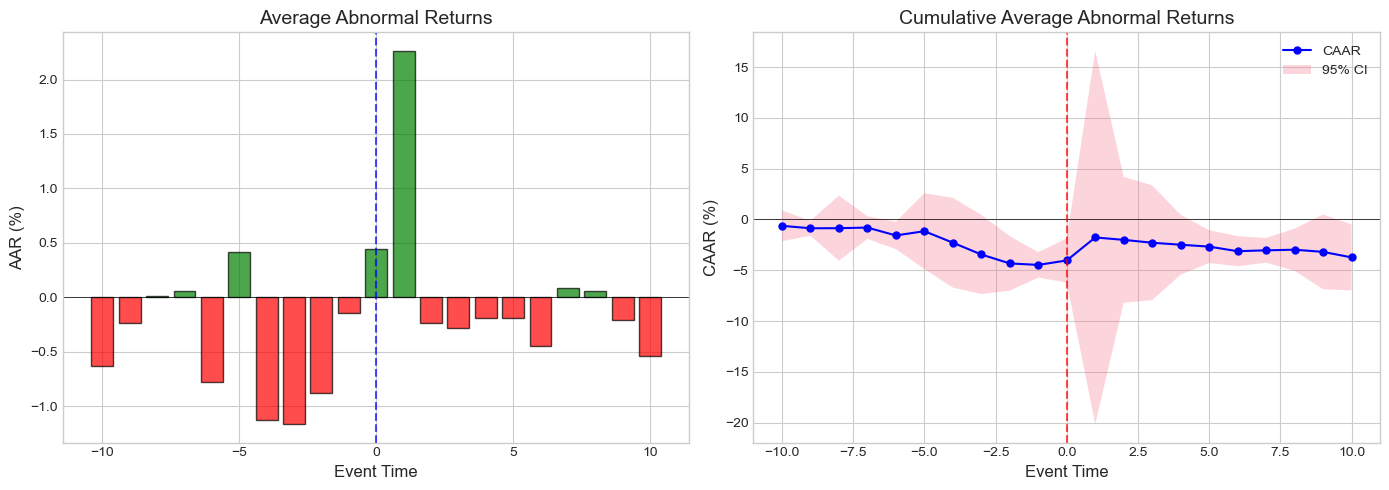
8. Wealth Effects and Economic Significance
Dollar Wealth Change
The CAR can be translated into dollar terms:
Where is the market value of equity before the event.
Aggregate Wealth Effect
Value-Weighted CAAR
Source
def get_market_cap(ticker: str, date: str) -> float:
    """
    Get approximate market cap for a stock.
    Uses price × shares outstanding.
    """
    try:
        stock = yf.Ticker(ticker)
        info = stock.info
        market_cap = info.get('marketCap', None)
        if market_cap:
            return market_cap
    except:
        pass

    # Fallback: use approximate values (in billions)
    approx_caps = {
        'AAPL': 2800e9,
        'MSFT': 2500e9,
        'GOOGL': 1700e9,
        'AMZN': 1400e9,
        'META': 800e9
    }
    return approx_caps.get(ticker, 100e9)


def calculate_wealth_effects(event_results: List[Dict], tau1: int, tau2: int) -> pd.DataFrame:
    """
    Calculate dollar wealth changes from event.
    """
    wealth_data = []

    for result in event_results:
        car = calculate_car(result['event_data'], tau1, tau2)
        mkt_cap = get_market_cap(result['ticker'], str(result['event_date']))
        wealth_change = car * mkt_cap

        wealth_data.append({
            'Ticker': result['ticker'],
            'Market Cap ($B)': mkt_cap / 1e9,
            f'CAR[{tau1:+d},{tau2:+d}]': car,
            'Wealth Change ($B)': wealth_change / 1e9
        })

    df = pd.DataFrame(wealth_data)

    # Add totals
    total_mkt_cap = df['Market Cap ($B)'].sum()
    total_wealth_change = df['Wealth Change ($B)'].sum()
    vw_car = total_wealth_change / total_mkt_cap

    return df, total_wealth_change, vw_car


# Calculate wealth effects for 3-day window
wealth_df, total_change, vw_car = calculate_wealth_effects(event_results, -1, +1)

print("Wealth Effects Analysis: CAR(-1, +1)")
print("="*70)

display_wealth = wealth_df.copy()
display_wealth['Market Cap ($B)'] = display_wealth['Market Cap ($B)'].apply(lambda x: f"${x:,.0f}")
display_wealth['CAR[-1,+1]'] = display_wealth['CAR[-1,+1]'].apply(lambda x: f"{x*100:+.2f}%")
display_wealth['Wealth Change ($B)'] = display_wealth['Wealth Change ($B)'].apply(lambda x: f"${x:+,.1f}")

print(display_wealth.to_string(index=False))
print(f"\nAggregate Statistics:")
print(f"  Total Wealth Change: ${total_change:+,.1f} billion")
print(f"  Value-Weighted CAAR: {vw_car*100:+.3f}%")
print(f"  Equal-Weighted CAAR: {np.mean(wealth_df['CAR[-1,+1]'])*100:+.3f}%")
Wealth Effects Analysis: CAR(-1, +1)
======================================================================
Ticker Market Cap ($B) CAR[-1,+1] Wealth Change ($B)
AAPL $3,670 -5.26% $-192.9
MSFT $3,353 -3.00% $-100.5
GOOGL $4,004 +6.22% $+249.1
AMZN $2,505 +8.96% $+224.6
META $1,632 +5.84% $+95.4
Aggregate Statistics:
Total Wealth Change: $+275.7 billion
Value-Weighted CAAR: +1.818%
Equal-Weighted CAAR: +2.555%
Source
# Visualize wealth effects
fig, axes = plt.subplots(1, 2, figsize=(12, 5))

# Bar chart of wealth changes
ax1 = axes[0]
colors = ['green' if x >= 0 else 'red' for x in wealth_df['Wealth Change ($B)']]
bars = ax1.bar(wealth_df['Ticker'], wealth_df['Wealth Change ($B)'], color=colors, alpha=0.7, edgecolor='black')
ax1.axhline(0, color='black', linewidth=0.5)
ax1.set_ylabel('Wealth Change ($ Billion)', fontsize=12)
ax1.set_title('Shareholder Wealth Change: CAR(-1,+1)', fontsize=14)

# Add value labels
for bar, val in zip(bars, wealth_df['Wealth Change ($B)']):
    height = bar.get_height()
    ax1.annotate(f'${val:+.0f}B',
                xy=(bar.get_x() + bar.get_width()/2, height),
                xytext=(0, 3 if height >= 0 else -10),
                textcoords="offset points",
                ha='center', va='bottom' if height >= 0 else 'top',
                fontsize=9)

# Scatter: Market cap vs CAR
ax2 = axes[1]
ax2.scatter(wealth_df['Market Cap ($B)'], wealth_df['CAR[-1,+1]']*100,
            s=100, alpha=0.7, edgecolors='black')

for i, row in wealth_df.iterrows():
    ax2.annotate(row['Ticker'],
                (row['Market Cap ($B)'], row['CAR[-1,+1]']*100),
                xytext=(5, 5), textcoords='offset points', fontsize=10)

ax2.axhline(0, color='black', linewidth=0.5)
ax2.set_xlabel('Market Cap ($ Billion)', fontsize=12)
ax2.set_ylabel('CAR (-1, +1) %', fontsize=12)
ax2.set_title('CAR vs Firm Size', fontsize=14)

plt.tight_layout()
plt.show()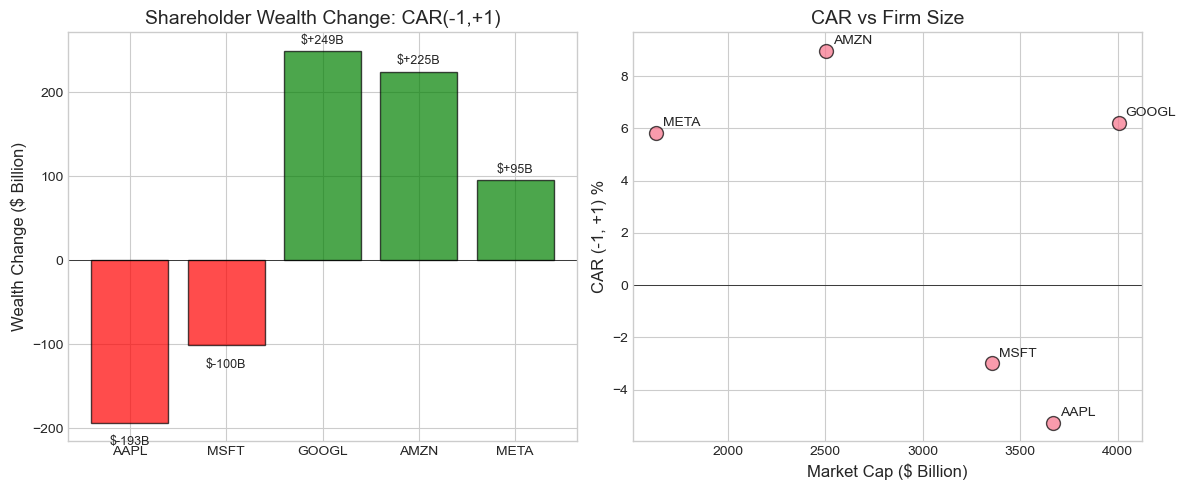
9. Precision-Weighted Measures
Motivation
Not all abnormal return estimates are equally precise. Firms with:
Higher residual variance → less precise AR estimates
Shorter estimation windows → more estimation error
Precision-Weighted CAR
Weight each firm’s CAR by the inverse of its variance:
Where
Source
def calculate_precision_weighted_caar(event_results: List[Dict],
                                       tau1: int, tau2: int) -> Dict:
    """
    Calculate precision-weighted CAAR.
    """
    cars = []
    weights = []  # Precision = 1/variance

    for result in event_results:
        car = calculate_car(result['event_data'], tau1, tau2)
        car_var = calculate_car_variance(result['model'], result['event_data'], tau1, tau2)

        precision = 1 / car_var if car_var > 0 else 0

        cars.append(car)
        weights.append(precision)

    cars = np.array(cars)
    weights = np.array(weights)

    # Normalize weights
    weights_norm = weights / np.sum(weights)

    # Precision-weighted CAAR
    pw_caar = np.sum(weights_norm * cars)

    # Standard error
    pw_var = 1 / np.sum(weights)
    pw_se = np.sqrt(pw_var)

    return {
        'PW_CAAR': pw_caar,
        'PW_SE': pw_se,
        'PW_t_stat': pw_caar / pw_se if pw_se > 0 else 0,
        'EW_CAAR': np.mean(cars),  # Equal-weighted for comparison
        'weights': weights_norm
    }


# Compare equal-weighted and precision-weighted CAAR
print("Equal-Weighted vs Precision-Weighted CAAR:")
print("="*70)

for tau1, tau2 in [(-1, +1), (0, 0), (-5, +5)]:
    pw_result = calculate_precision_weighted_caar(event_results, tau1, tau2)

    print(f"\nWindow [{tau1:+d}, {tau2:+d}]:")
    print(f"  Equal-Weighted CAAR:     {pw_result['EW_CAAR']*100:+.3f}%")
    print(f"  Precision-Weighted CAAR: {pw_result['PW_CAAR']*100:+.3f}%")
    print(f"  PW t-statistic:          {pw_result['PW_t_stat']:+.3f}")
Equal-Weighted vs Precision-Weighted CAAR:
======================================================================
Window [-1, +1]:
Equal-Weighted CAAR: +2.555%
Precision-Weighted CAAR: -1.238%
PW t-statistic: -1.208
Window [+0, +0]:
Equal-Weighted CAAR: +0.439%
Precision-Weighted CAAR: -0.004%
PW t-statistic: -0.007
Window [-5, +5]:
Equal-Weighted CAAR: -1.100%
Precision-Weighted CAAR: -4.379%
PW t-statistic: -2.235
10. Handling Event Clustering
The Problem
When events cluster in calendar time (e.g., earnings season), the independence assumption is violated. Cross-sectional correlation inflates test statistics.
Solutions
Portfolio approach: Form portfolios of stocks with events on the same day
Crude dependence adjustment: Reduce degrees of freedom
Calendar-time portfolio: Regress portfolio returns on factors
Clustered standard errors: Allow for within-period correlation
Source
def check_event_clustering(event_results: List[Dict]) -> pd.DataFrame:
    """
    Check for event clustering in calendar time.
    """
    dates = [result['event_date'] for result in event_results]
    tickers = [result['ticker'] for result in event_results]

    df = pd.DataFrame({'Ticker': tickers, 'Event_Date': dates})

    # Count events per date
    cluster_count = df.groupby('Event_Date').size().reset_index(name='N_Events')

    return df.merge(cluster_count, on='Event_Date')


def crude_dependence_adjustment(event_results: List[Dict], tau1: int, tau2: int) -> Dict:
    """
    Crude dependence adjustment for clustered events.
    Reduces effective N based on clustering.
    """
    cluster_df = check_event_clustering(event_results)

    # Effective N = number of unique event dates
    n_effective = cluster_df['Event_Date'].nunique()
    n_actual = len(event_results)

    # Calculate CAAR
    caar_result = calculate_caar(event_results, tau1, tau2)

    # Adjust standard error
    adjustment_factor = np.sqrt(n_actual / n_effective)
    adjusted_se = caar_result['CS_SE'] * adjustment_factor
    adjusted_t = caar_result['CAAR'] / adjusted_se if adjusted_se > 0 else 0

    return {
        'N_actual': n_actual,
        'N_effective': n_effective,
        'CAAR': caar_result['CAAR'],
        'SE_unadjusted': caar_result['CS_SE'],
        'SE_adjusted': adjusted_se,
        't_unadjusted': caar_result['t_stat_CS'],
        't_adjusted': adjusted_t
    }


# Check clustering
cluster_df = check_event_clustering(event_results)
print("Event Clustering Analysis:")
print("="*50)
print(cluster_df.to_string(index=False))

print(f"\nUnique event dates: {cluster_df['Event_Date'].nunique()}")
print(f"Total events: {len(event_results)}")

# Apply crude dependence adjustment
print("\nCrude Dependence Adjustment (CAR[-1,+1]):")
adj = crude_dependence_adjustment(event_results, -1, +1)
print(f"  Unadjusted t-stat: {adj['t_unadjusted']:+.3f}")
print(f"  Adjusted t-stat:   {adj['t_adjusted']:+.3f}")
Event Clustering Analysis:
==================================================
Ticker Event_Date N_Events
AAPL 2023-08-03 2
MSFT 2023-07-25 2
GOOGL 2023-07-25 2
AMZN 2023-08-03 2
META 2023-07-26 1
Unique event dates: 3
Total events: 5
Crude Dependence Adjustment (CAR[-1,+1]):
Unadjusted t-stat: +0.912
Adjusted t-stat: +0.706
11. Summary Statistics Table
A complete event study report should include summary statistics.
Source
def create_summary_table(event_results: List[Dict], windows: List[Tuple[int, int]]) -> pd.DataFrame:
    """
    Create a comprehensive summary table for event study results.
    """
    summary = []

    for tau1, tau2 in windows:
        cars = []
        for result in event_results:
            car = calculate_car(result['event_data'], tau1, tau2)
            cars.append(car)

        cars = np.array(cars)
        n = len(cars)

        # Calculate statistics
        mean_car = np.mean(cars)
        median_car = np.median(cars)
        std_car = np.std(cars, ddof=1)
        se = std_car / np.sqrt(n)
        t_stat = mean_car / se if se > 0 else 0

        # Count positive
        n_positive = np.sum(cars > 0)
        pct_positive = n_positive / n * 100

        # Sign test
        sign_stat = (n_positive - n/2) / np.sqrt(n/4)

        summary.append({
            'Window': f'[{tau1:+d},{tau2:+d}]',
            'N': n,
            'Mean CAR': mean_car,
            'Median CAR': median_car,
            'Std Dev': std_car,
            't-stat': t_stat,
            '% Positive': pct_positive,
            'Sign Stat': sign_stat
        })

    return pd.DataFrame(summary)


# Create summary table
summary_table = create_summary_table(event_results, standard_windows)

print("\n" + "="*90)
print("EVENT STUDY SUMMARY STATISTICS")
print("="*90)
print(f"Sample: {len(event_results)} Big Tech Earnings Announcements (Q2-Q3 2023)")
print(f"Estimation Window: {ESTIMATION_WINDOW} days")
print(f"Model: Market Model (S&P 500 benchmark)")
print("="*90)

display_summary = summary_table.copy()
display_summary['Mean CAR'] = display_summary['Mean CAR'].apply(lambda x: f"{x*100:+.3f}%")
display_summary['Median CAR'] = display_summary['Median CAR'].apply(lambda x: f"{x*100:+.3f}%")
display_summary['Std Dev'] = display_summary['Std Dev'].apply(lambda x: f"{x*100:.3f}%")
display_summary['t-stat'] = display_summary['t-stat'].apply(lambda x: f"{x:+.3f}")
display_summary['% Positive'] = display_summary['% Positive'].apply(lambda x: f"{x:.0f}%")
display_summary['Sign Stat'] = display_summary['Sign Stat'].apply(lambda x: f"{x:+.3f}")

print(display_summary.to_string(index=False))
print("\nSignificance: |t| > 1.645 (10%), |t| > 1.96 (5%), |t| > 2.576 (1%)")
==========================================================================================
EVENT STUDY SUMMARY STATISTICS
==========================================================================================
Sample: 5 Big Tech Earnings Announcements (Q2-Q3 2023)
Estimation Window: 120 days
Model: Market Model (S&P 500 benchmark)
==========================================================================================
   Window  N Mean CAR Median CAR Std Dev t-stat % Positive Sign Stat
 [-10,-2]  5  -4.328%    -2.109%  4.372% -2.214         0%    -2.236
  [-1,+1]  5  +2.555%    +5.842%  6.269% +0.912        60%    +0.447
  [+0,+0]  5  +0.439%    +0.765%  0.744% +1.319        80%    +1.342
  [-5,+5]  5  -1.100%    -3.200%  7.250% -0.339        40%    -0.447
 [+2,+10]  5  -1.960%    -3.070%  2.608% -1.681        20%    -1.342
[-10,+10]  5  -3.733%    -7.413%  7.841% -1.065        40%    -0.447

Significance: |t| > 1.645 (10%), |t| > 1.96 (5%), |t| > 2.576 (1%)
12. Exercises
Exercise 1: Alternative Benchmarks
Recalculate abnormal returns using:
Market-adjusted returns (beta = 1)
Industry-adjusted returns (use sector ETF)
Exercise 2: Long-Horizon BHAR
Extend the event window to [-20, +20] days. Calculate both CAR and BHAR. How much do they diverge?
Exercise 3: Subsample Analysis
Split the sample by some characteristic (e.g., positive vs negative earnings surprise if you can identify it). Do the subsamples show different patterns?
Exercise 4: Bootstrap Confidence Intervals
Implement bootstrap confidence intervals for CAAR instead of assuming normality.
Source
# Exercise 4 Template: Bootstrap CAAR

def bootstrap_caar(event_results: List[Dict], tau1: int, tau2: int,
                   n_bootstrap: int = 1000) -> Dict:
    """
    Bootstrap confidence intervals for CAAR.
    """
    # Calculate individual CARs
    cars = np.array([calculate_car(r['event_data'], tau1, tau2) for r in event_results])
    n = len(cars)

    # Original CAAR
    original_caar = np.mean(cars)

    # Bootstrap
    bootstrap_caars = []
    for _ in range(n_bootstrap):
        # Resample with replacement
        sample_idx = np.random.choice(n, size=n, replace=True)
        sample_cars = cars[sample_idx]
        bootstrap_caars.append(np.mean(sample_cars))

    bootstrap_caars = np.array(bootstrap_caars)

    # Confidence intervals
    ci_90 = np.percentile(bootstrap_caars, [5, 95])
    ci_95 = np.percentile(bootstrap_caars, [2.5, 97.5])
    ci_99 = np.percentile(bootstrap_caars, [0.5, 99.5])

    return {
        'CAAR': original_caar,
        'Bootstrap_SE': np.std(bootstrap_caars),
        'CI_90': ci_90,
        'CI_95': ci_95,
        'CI_99': ci_99
    }


# Run bootstrap
print("Bootstrap Confidence Intervals for CAAR(-1, +1):")
print("="*50)

boot_result = bootstrap_caar(event_results, -1, +1, n_bootstrap=5000)

print(f"CAAR: {boot_result['CAAR']*100:+.3f}%")
print(f"Bootstrap SE: {boot_result['Bootstrap_SE']*100:.3f}%")
print(f"90% CI: [{boot_result['CI_90'][0]*100:+.3f}%, {boot_result['CI_90'][1]*100:+.3f}%]")
print(f"95% CI: [{boot_result['CI_95'][0]*100:+.3f}%, {boot_result['CI_95'][1]*100:+.3f}%]")
print(f"99% CI: [{boot_result['CI_99'][0]*100:+.3f}%, {boot_result['CI_99'][1]*100:+.3f}%]")
Bootstrap Confidence Intervals for CAAR(-1, +1):
==================================================
CAAR: +2.555%
Bootstrap SE: 2.522%
90% CI: [-1.960%, +6.695%]
95% CI: [-2.508%, +7.244%]
99% CI: [-3.901%, +7.868%]
13. Summary
In this session, we covered:
Daily Abnormal Returns (AR): The building block of event studies
Cumulative Abnormal Returns (CAR): Summing ARs over event windows
Buy-and-Hold Abnormal Returns (BHAR): Compounding for true wealth effects
Standardized Abnormal Returns (SAR/SCAR): Improving cross-sectional comparability
Aggregation Methods:
Average Abnormal Return (AAR)
Cumulative Average Abnormal Return (CAAR)
Precision-weighted aggregation
Economic Interpretation:
Dollar wealth changes
Value-weighted vs. equal-weighted measures
Event Clustering: The problem and solutions
Key Takeaways
CAR and BHAR are nearly identical for short windows
Standardization improves statistical power
Always report multiple windows for robustness
Consider economic significance, not just statistical significance
Watch out for event clustering
Coming Up Next
Session 4: Statistical Inference I - Parametric Tests will cover:
The Patell test
Boehmer-Musumeci-Poulsen (BMP) test
Cross-sectional vs. time-series variance
Event-induced variance
14. References
Methodology
Fama, E. F. (1998). Market efficiency, long-term returns, and behavioral finance. Journal of Financial Economics, 49(3), 283-306.
Barber, B. M., & Lyon, J. D. (1997). Detecting long-run abnormal stock returns: The empirical power and specification of test statistics. Journal of Financial Economics, 43(3), 341-372.
Lyon, J. D., Barber, B. M., & Tsai, C. L. (1999). Improved methods for tests of long-run abnormal stock returns. Journal of Finance, 54(1), 165-201.
Applications
MacKinlay, A. C. (1997). Event studies in economics and finance. Journal of Economic Literature, 35(1), 13-39.
Kothari, S. P., & Warner, J. B. (2007). Econometrics of event studies. Handbook of Corporate Finance, 1, 3-36.